 />


Finding better ways
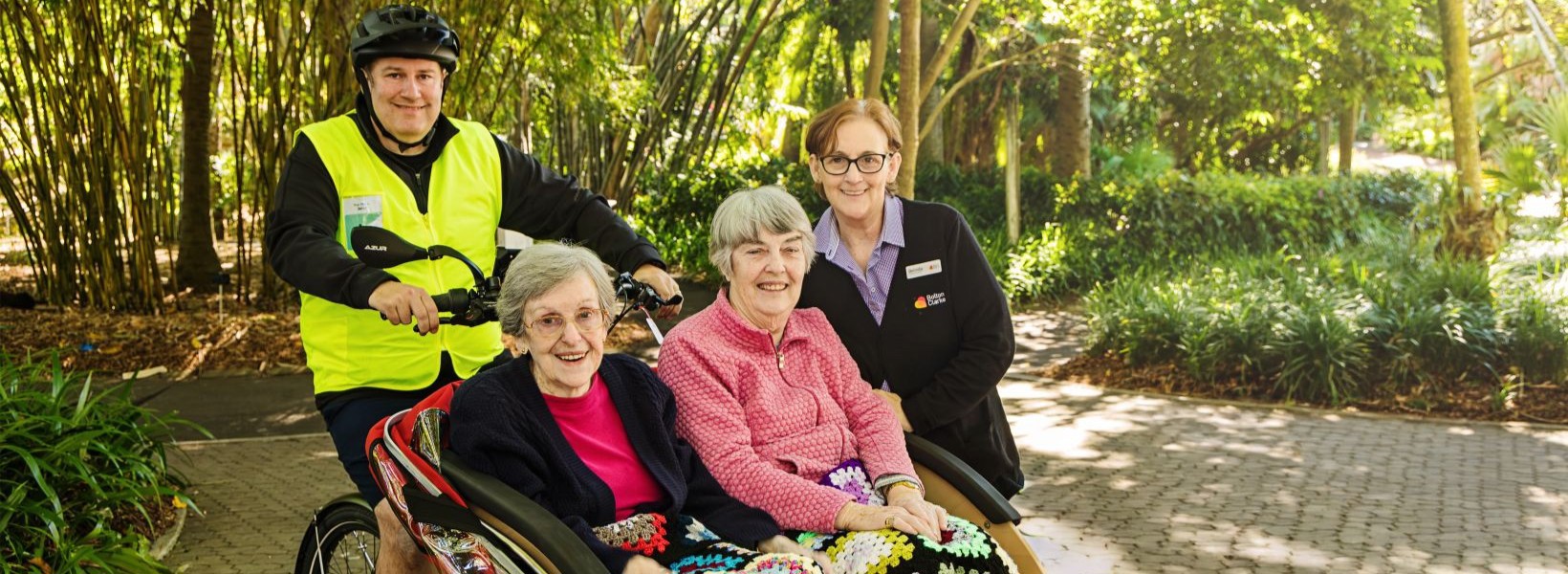
What connects food scraps, cycling trips, a pre-loved shirt, a solar panel and a hospital bed bound for Papua New Guinea? They’re all part of our sustainability story, showing how different ideas and everyday actions can add up to make a difference.
Across Bolton Clarke, that story is taking many forms – from the care we provide and the resources we use, to the way we support our teams, connect with communities and rethink how things are done.
Read on to find out how new approaches are helping reduce waste, make better use of resources, and bring fresh thinking to established practices.
When leftovers become energy
Food scraps from our NSW residential care homes are being turned into valuable resources through the introduction of food organics bins.
Part of the NSW government’s FOGO (Food Organics and Garden Organics) initiative, the bins collect food scraps that would otherwise go to landfill.
Once collected, the food scraps are transferred to EarthPower, Australia’s first food waste-to-energy facility. Run by Veolia, EarthPower processes the waste to produce green energy that is distributed to the local community. A nutrient-rich soil improver is also created for use in agricultural and horticultural industries.
During a recent tour of the EarthPower facility, members of our sustainability, procurement and hospitality teams saw the innovative technology in action.
Sustainability Manager Kathryn Wightman-Beaven said it was great to see firsthand the impact of teams’ recycling efforts.
“Over the past few months, our NSW residential care teams have put in a big effort to learn the do’s and don’ts of using the bins and incorporate them into daily practices.” she said.
Caption:
Kathryn Wightman-Beaven (centre) with Regional Hospitality Services Manager Manish Arora and Procurement Contract Manager Carmel Thomsen on tour at the EarthPower recycling facility.
Partnerships with purpose
Through new and existing partnerships, we are extending our positive impact to benefit the environment and people in need.
Our work with Wounded Heroes Australia supports veterans through initiatives such as repurposing surplus furniture and featuring the organisation’s unique blend of coffee in welcome packs for new village residents.
In Central Queensland, we recently donated more than 60 decommissioned beds from our Sunset Ridge residential care home to Rotary Australia Repurposing Equipment (RARE), with the beds going on to support health services in Papua New Guinea where clinical equipment is limited.
Old laptops and other devices are also enjoying a new lease of life through our partnership with Moorup Technology. In 2026, almost 75 per cent of our end-of-life devices were repurposed or recycled, preventing 85 kg of e-waste from entering landfill.
Through our partnership with social enterprise Reforest, we are supporting the restoration of the Mabi Forest in Queensland, with a tree planted for every new retirement living resident welcomed into our retirement living communities from 1 July.
The state-wide Containers for Change program across all Queensland retirement villages is also creating benefits for local communities, with more than 31,000 containers recovered between April and June. Funds generated are directed to local community groups and charities nominated by residents, including Wounded Heroes Australia, Act for Kids and Mates4Mates.
Together, these partnerships are giving resources new purpose, supporting local causes and helping restore the environment.
Rethinking waste in diabetes care
Our clinical teams are also finding ways to reduce waste in everyday care.
A recent review looked at the use of reusable diabetes equipment, including personal lancets and insulin pens where clinically appropriate to reduce unnecessary reliance on disposable products.
The initiative brought together experts in diabetes care, infection prevention and control, and clinical governance to support consistent, evidence-based practice.
Updated procedures, education and resources were developed to help our nursing teams support client choice while maintaining high standards of care and infection prevention.
A brighter way to power
Our three largest communities in Western Australia are now powered by 100 per cent renewable energy under a new energy supply contract.
The contract covers our Jurien Bay, Meadow Springs and Menora Gardens communities, which use a combined total of about 2,600 MWh of electricity each year.
Chief Financial Officer Megan Millman said the contract would reduce greenhouse gas emissions by 1,300 tonnes of CO2-e each year and was part of a significant focus on sustainable energy across the Group.
“As an organisation with a national footprint, we have been tackling this issue from multiple directions,” Megan said.
“With the reduced cost of purchasing renewable energy over the past few years, participating in the GreenPower program, which guarantees 100 per cent renewable supply, made sense when our WA contract came up for renewal.”
Another recent highlight was the completion of the solar roll-out across our 86 residential care homes.
Property Development Manager David Brophy said the roll-out was expected to generate 6.9GWh of electricity and offset more than 5,000 tonnes of CO2 annually – equivalent to the annual emissions of about 1,020 average Australian households.
“With completion of this project, solar is expected to supply about one in five units of electricity used across participating homes, reducing grid electricity purchases during daylight hours,” he said.
Caption: Solar array at Sunset Ridge residential care home.
Designed for tomorrow
At The Aurelian, our newest retirement living community, sustainability has helped shape the design from the outset.
Currently under construction in New Farm, Brisbane, the development targets an average NatHERS rating of approximately 8 stars, exceeding the minimum National Construction Code requirements.
Features such as insulation, low-e glazing and thermal breaks are designed to improve resident comfort while reducing energy demands. A 60 kW rooftop solar system will supply renewable electricity to common areas, and EV charging infrastructure will be available for resident use.
Water efficiency is integrated through WELS-rated fixtures, drought-tolerant landscaping and 30,000 litres of rainwater storage. A flood-responsive design and stormwater management infrastructure support climate resilience, while high-performance building materials and advanced weatherproofing systems will help manage the impacts of extreme heat, severe storms and future climate risks.
During construction, more than 90 per cent of building materials have been recycled and diverted from landfill.
Importantly, The Aurelian is designed to support ageing in place through accessible and adaptable apartments, extensive landscaped areas, and approximately 1,000 m2 of communal space. Resident insights informed the design process, helping ensure the community responds to future needs.
Caption: Artist’s impression of The Aurelian’s rooftop and BBQ area.
Every thread makes a difference
Our uniforms are another way we’re making sustainability part of our everyday work.
The eco-friendly fabric is made from recycled plastic bottles blended with bamboo – one of the fastest regenerating natural crops.
Our Heritage Polos are designed without buttons to minimise excess trims, while responsible and ethical sourcing and manufacturing practices are part of every stage of production.
We’ve also implemented a recycling process to keep old uniforms out of landfill and give them a new life in a range of fabric products.
Download the magazine to read how residents and clients are also bringing sustainability to life through shared interests, resourceful ideas and activities that bring people together.
The bigger picture
Our FY27-30 Sustainability Strategy brings together our focus on our people and customers, stronger communities and caring for our planet.
Shaped by customer and employee insights, it provides a shared direction for the work ahead. The strategy focuses on three areas of impact:
Our people and customers
Creating safe, inclusive and resilient services, supporting our workforce, and embedding sustainability into decision-making across the organisation.
Stronger communities
Building meaningful partnerships and delivering value for the communities in which we operate.
Caring for our planet
Understanding and managing our environmental footprint, improving resource efficiency, reducing emissions and waste, and strengthening sustainable supply chains.
The strategy is aligned with the United Nations Sustainable Development Goals (SDGs), helping connect our actions with globally recognised sustainability priorities.
Visit the Sustainability page on Connect to find out more, or contact Kathryn Wightman-Beaven if you would like to join the Sustainability Community of Interest.